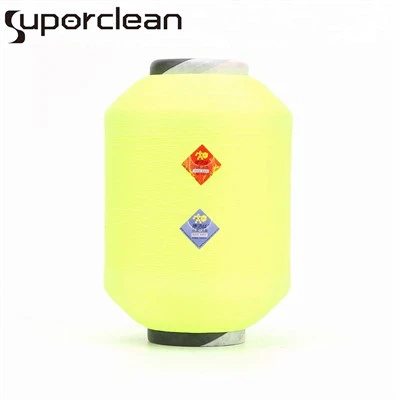


| Quick Details | |||
| Type: | Double Covered Yarn | Raw Material: | Latex/Spandex + polyester/nylon |
| Cover Style: | Double covering | Technics: | As request |
| Use: | Knitted Socks | Evenness: | High standard |
| Pattern: | Raw | Yarn Count: | As request |
| Strength: | High standard | Place of Origin: | Zhejiang, China |
| Draft Ratio: | 3.5 | Model Number: | 1407575 |
| Application: | Ribbons knitting | Weight(g/cone) | 500g/cone |
| MOQ: | 10KGS | Colour: | Rw black colors |
| Features: | Eco-Friendly | Packing: | Export Standard (cartons) |
| Certification: | Oeko-Tex Standard +GRS+ISO9001 | ||
Supply Ability &Packaging &Delivery
Supply Ability
Supply Ability 10000 Kilogram/Kilograms per Month
Packaging & Delivery
Packaging Details 65cm*45cm*36cm also can with pallets
Lead Time:
|
Quantity(Kilograms) |
1 - 1000 |
>1000 |
|
Est. Time(days) |
7 |
To be negotiated |
|
Double covered yarn (DCY |
||
|
Raw material: |
Spandex/latex + Polyester/nylon |
|
|
color: |
raw white, black, colors as request |
|
|
Packing: |
PP bags/cartons carton size 65*45*36.5 0.5kg/cone,24kg/carton 23kg/bag 268carton/20ft 400bags/20ft 635carton/40hq 715bags/40hq |
|
|
spandex double covered yarn |
spandex+polyester |
1407575,2107575,560150150,2807575,etc. |
|
spandex+nylon |
1407070,2107070,4207070,560140140, etc. |
|
|
latex double covered yarn |
latex+polyester |
907575,1007575,1107575,63#150150,52#150150 etc. |
|
latex+nylon |
907070,1007070,1107070etc. |
|
| More details can be customized. | ||
| Samples can be sent to check whether conform to your requirements. | ||
PRODUCT APPLICATION

PRODUCTION LINE
We have been professionally working on manufacturing double covered yarn for 20 years.
1 SPOOLING
Purchasing high-quality material and spooling it onto aluminium tube
2 THREADING
Threading spandex, polyester, or nylon on the machine to start the covering.
3 DOFFING
After finishing, doffing the spandex covered yam onto yan carrier.
4 CHECKING
Checking if there is ill-shaped yam or quality issue.
5 PACKING
Every carton using the plastic tape with same length and width.
6 WAREHOUSING
Storing yarn in warehouse and keeping the stable temperature and moisture.
7 LOADING
Loading the carton into container.


FAQ
Q: What is the difference between covered yarn and core-Spun yarn.
A:Spandex is a kind of high elastic fiber, with a small amount of spandex fiber and other into a certain scale. Mixed use of fibers, woven elastic fabric can be used in tight underwear, shirts, sportswear, jeans, casual wear and other clothing, favored by consumers.
The soft chain segment of spandex fiber chain structure has two types of polyester and polyether, which are divided into polyester spandex and polyether spandex. General polyether type spandex than polyester type spandex glass temperature is lower, good elasticity.
Spandex core-spun yarn is a yarn made of spandex yarn with one or several non-elastic staple fibers outsourced. The core of a core-spun yarn is surrounded by an outer fiber, which is tightly combined and has the same twist as the outer fiber.
It has three notable features:
First, it has the same feel and appearance as the outsourcing fibers (cotton, wool, polyester, cotton, etc.), and the outer sheath composed of natural fibers has good hygroscopic property;
Second, good elasticity;
Third, the percentage of elasticity can be controlled below 20%.
Compared with other elastic yarns, spandex core-spun yarn has a remarkable feature that the core yarn is not exposed when the yarn is stretched. Therefore, the dyeing effect is good, it is appropriate to do a variety of colors including dark products.
Compared to other types of elastic yarns, core-spun yarns have relatively low strength. In general, the strength of a single yarn is only equivalent to 80% ~ 90% of the same size of the outsourcing fiber alone into yarn.
The first thing that core-spun yarn breaks is the outside fiber, and the strength formed by the outside fiber is the strength of the core yarn. Spandex is a filament with low strength and high stretch. It does not contribute to the strength of the yarn in the core-spun yarn, but destroys the adhesion between the fibers.
Therefore, the higher the content of spandex, the lower the strength of core-spun yarn.
Q:What are the advantages and disadvantages of spandex
A:The biggest characteristic of spandex fiber is that it has high elasticity and good resilience as rubber bands, and it is 2~4 times stronger than rubber bands. After stretching, it has a higher elastic recovery rate and a smaller density, and it is very resistant to bending. Rubber bands, for example, can break after being bent 500 times, while spandex can break up to 10,000 times. It is also more resistant to aging, oil and chemicals than rubber bands. Although spandex has many advantages over rubber bands, it is not as strong as other fibers, so it is rarely used alone. It is generally combined with other fiber twist, core and compound to make up for the deficiency.
Q:What is the spandex yarn?
A:The research of spandex began in the 1930s. In 1937, the German Bayer Company developed spandex for the first time and applied for a patent. In 1959, the American DuPont company developed its own technology and started industrial production, and named it Lycra.
At the same time, American Rubber Co., Ltd. introduced thick-branched circular monofilament made of polar-polyurethane under the brand name "Vyrene," and in 1963 the Japanese Toyo Textile Company began production of spandex under the brand name "Espa." In 1964, Bayer of Germany and Fujibo of Japan launched Dorlastan and Fujibo, respectively
"Spandex" brand Spandex production, Dupont company and Japan Toray Corporation joint venture "Toray DuPont" also started the production of "Lycra" in 1966.
By 1967, the world's annual output of spandex had reached 6.8kt /a, and the production plants had developed to 28. However, due to the problems of production and application technology and the forecast demand is too large, so that spandex products unsalable backlog, many manufacturers in Europe and the United States have stopped, production reduction.
In the late 1960s, the world spandex production was less than 10 kt/a. After the 1970s, except for DuPont Company, almost stayed at the original level, the development of spandex industry is not big. In the 1980s, due to the successful development of the application technology of spandex coating yarn and core-spun yarn, the production capacity had a great development and increased to around 20 kt/a.
In the 1990s, with the improvement of the world economic situation and the expansion of the latter uses (such as the development of spandex core technology), spandex elastic fabric began a new round of production climax. The consumption of spandex increased rapidly. In 1990, the world output of spandex was close to 40 kt/a. In 1994 the total production capacity was 81 kt/a and the total output was 64 kt/a.
Into the late 1990s, due to the polyester fiber market is not good and other reasons, some foreign chemical fiber manufacturers have turned their investment focus to the profit rate is relatively good spandex industry, at present the world spandex capacity has reached nearly 150kt/a.
Especially in recent years, many large foreign companies have developed their own unique spandex production technology, and the product quality has been greatly improved, such as Korea Taekwang, Hyosung, Dongguk, etc. The production expansion speed is also quite fast. Currently, Korea Hyosung has become the world's second largest spandex manufacturer with an annual production capacity of 25kt/a. At the same time, melt spinning technology has also made a breakthrough, in some application fields has been comparable with dry spinning products, because of its low investment cost and advantages in environmental protection, development is also fast.
The United States was the world's leading producer of spandex before the turn of the century, with major manufacturers such as Du Pont, Globe, and Miles. Du Pont is the world's largest industrial spandex producer, with the latest production capacity estimated to exceed 70kt/a.
"Lycra" is its famous brand. Dupont owns spandex plants in the United States, the United Kingdom, the Netherlands, Brazil and Singapore. We have joint ventures in Canada, Mexico, Argentina and China. The production of spandex in Korea has developed rapidly. Major companies such as Taekwang, Dongguk, Hyosung, and Korea Composite Fiber also introduced the technology of Dongyang Textile in the early stage, and completed the upgrading of technological level through R&D and other means in the late 1990s. At present, the quality and output of spandex are inferior to those of the United States.
Hot Tags: covered elastomeric yarn, China, suppliers, manufacturers, factory, wholesale, cheap, business opportunity covered yarn