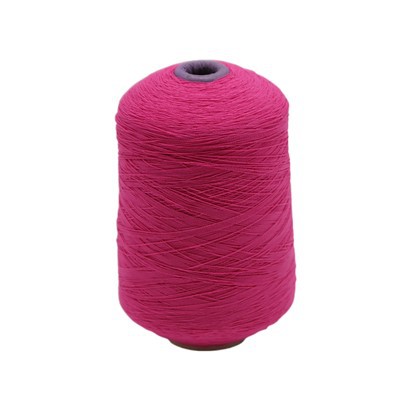

- The yarn is constructed with a latex rubber filament as the central elastic carrier, which generates tensile force during stretching and provides the primary recovery behavior. Around the latex core, a continuous fiber covering layer (polyester / nylon / cotton) is wrapped through controlled winding to form a protective and load-distributing outer structure.
- During extension, mechanical stress is first absorbed by the covering fibers and then transferred to the latex core, creating a core-to-sheath stress distribution path. This structure reduces direct friction between the latex core and machine contact points, preventing core exposure, surface damage, and localized wear during repeated deformation cycles.

Industrial Operating Environment

- In textile production systems, the yarn operates under continuous tension feeding conditions, where constant pulling force is applied through guide rollers and tension control units. During knitting or weaving, it is exposed to cyclic stretching loads caused by repeated loop formation and release cycles.
- In high-speed knitting machines, the yarn passes through rotating feeder systems and metal guide components, where friction contact occurs at multiple angles. Under these conditions, the yarn must maintain structural integrity while undergoing continuous deformation.
- Long-term operation introduces fatigue stress accumulation, especially at high-frequency stretch–recovery cycles. Performance stability depends on maintaining controlled tension settings, consistent winding density, and stable interaction between latex core elasticity and outer covering layer.
Working Environment


FAQ
What is the structure of Latex Core Elastic Yarn?
The yarn consists of a latex rubber core as the elastic element, wrapped by fiber layers such as polyester, nylon, or cotton. The covering layer distributes external stress and protects the latex core during mechanical contact.
How does the latex core provide elasticity?
Elastic force is generated by the stretch–recovery behavior of the latex rubber core. When tension is applied, the core elongates and stores mechanical energy, then returns to its original state during release.
What causes yarn breakage during processing?
Breakage usually occurs under excessive cyclic tension or uneven feed conditions, especially at guide rollers or needle contact zones where localized stress is concentrated.
Hot Tags: latex elastic core yarn, China, suppliers, manufacturers, factory, wholesale, cheap