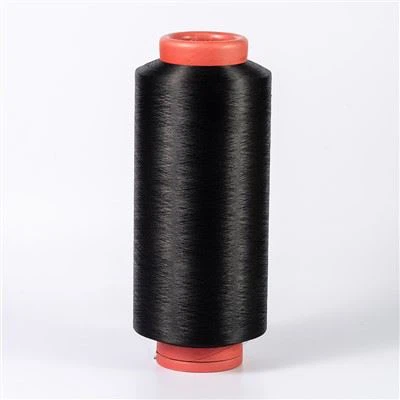


| Quick Details | |||
| Type: | Air Covering Yarn For Weaving | Material: | polyester, spandex |
| Style: | Air Covering | Technics: | Draw Ratio |
| Use: | For denim or socks making | Evenness: | Standard |
| Twist: | S/Z | Yarn Count: | 3075/4075/2075 |
| Strength: | Standard | Place of Origin: | Zhejiang, China |
| payment: | LC OR TT | Model Number: | 2075 |
| Colour: | White, Black, Color | Weight/carton: | 32kgs |
| MOQ: | 1000KGS | Features: | Eco-Friendly |
| Packing: | Export Standard | Certification: | Oeko-Tex Standard 100 and GRS |
| Grade: | AA Grade | Brand Name: | kangjiesi |
| Technical Point: | As customer request | Port: | Ningbo or Shanghai |
Supply Ability &Packaging &Delivery
Supply Ability
Supply Ability 30000 Kilogram/Kilograms per Month
Packaging & Delivery
Packaging Details 69cm*46.5cm*30cm
Lead Time:
|
Quantity(Kilograms) |
1 - 5000 |
>2000 |
|
Est. Time(days) |
7 |
To be negotiated |
|
Air-covered yarn (ACY) |
|
|
Raw material: |
Spandex + Polyester/nylon |
|
Twist: |
S/Z |
|
color: |
raw white, black, colors as requested |
|
Packing: |
PP bags inside, cartons outside carton size 69*46.5*30 5kg/cone,30kg/carton 300carton/20ft 700cartons/40hq |
|
spandex+polyester |
1575 2055 4055 2075 3075 4075 20150 30150 40150 70150 |
|
spandex+nylon |
2020 2030 2040 2070 3070 7070 7040 |
|
Certification: |
OEKO-TEX certification |
|
Application: |
Socks, Denim, Underwear, Swimwear, Sportswear, Gloves, Tights, Sweaters, Pantyhose, and other textile products |
| More details can be customized. | |
| Samples can be sent to check whether conform to your requirements. | |

PRODUCT APPLICATION


FAQ
Q:What is hand textile?
A:
Textile production began at different times in different parts of the world. Around 5000 BC, the world's civilizations had begun to use local materials for textile production. For example, the people of the Nile Valley in North Africa use flax to textile; Residents in the Yellow River and Yangtze River in China make use of kudzu and hemp for weaving. The Indus Valley people in South Asia and the Inca Empire people in South America have used cotton for weaving. Wool was already woven in Asia Minor. The original spinning tools and original weaving machine parts of this period have appeared in Hebei and Zhejiang of China, the Indus River valley of South Asia and Egypt of North Africa. There are two kinds of vertical and horizontal spinning. Ancient hand-spinning images of hanging wool were used on vases preserved in Greece from 550 BC, while ethnic minorities in southwest China preserved ancient techniques of vertical spinning on a knee. In the Andean region of South America, horizontal spinning is specially placed on the leg. There are two types of original loom, the hanging loom and the tiling loom. The two axes of the tiling loom are fixed to the ground with four wooden piles. An image of this type of ground loom is painted on a pottery dish from 4000 BC unearthed in Egypt. There is also a flat loom with the weaver's feet against the warp shaft, and the weaver tied to the waist is the original waist machine. A pottery bowl dating back to 200 BC has been unearthed in Peru with an ancient primitive image of a waist machine. The warp shaft of the hanging loom is hung on it, and the warp drops naturally by its own weight or by the hanging hammer, and is woven into the weft in turn. The Ojebwe tribe of North America used this loom to weave sacks, called the vertical loom. There is another narrow ribbon machine with square or polygonal heald plate opening, called heald plate loom. Such looms have been found in relics dating from 900 BC in Egypt and 200 BC in Scandinavia. The primitive loom initially separated the warp lines directly with the fingers, and later switched to a stick opening and filling. This kind of stick gradually evolved, and there were differences in shape, thickness and function, that is, there was a division of the heald rod (or heald rod), the dividing rod and the beating knife. The rod has also been developed from one to several or ten to meet the needs of the weaving pattern. The position is also moved from between the two sets of warp threads to above the warp plane, and the heald rings around the rod are sagging and placed on each of the sets of warp threads one by one to form a hanging rod. This kind of hanging rod and outer frame is the later widely used heald frame. Traditional vertical looms in Guerrero, Mexico, and the Pueblo region of southwest North America still have this early style of heald frame.
Humans have used mineral pigments for coloring in the Paleolithic period, such as the Chinese cavemen and the European Cro-nons. Ancient colored fabrics have been found in many parts of the world. In China, plant dyes such as madder, indigo, isatis, and safflower were used in 3000 BC. Madder and indigo were used in India in 2500 BC; Egypt used isatis indigotica and safflower in 2000 BC; Peruvians have long known how to make insect red dye.
The textile products of the Neolithic age were mainly all kinds of short fiber fabrics. Such as linen in the Nile valley of North Africa; Cotton fabrics from the Ganges and Indus valleys of South Asia; Cotton and wool interwoven fabrics from the Huagapuliante region of South America and cotton and sisal interwoven fabrics woven by the Mayans; Woolen fabrics from the shores of the Caspian Sea, the Aegean Sea and the Mesopotamia of Western Asia; Silk fabrics from the Yellow and Yangtze Rivers of China. On these fabrics, some use hand-painted patterns, some use weaving to form simple patterns, and some use embroidery. It is thought that the ancient inhabitants of the Caucasus region even had primitive prints.
Hot Tags: air covering yarn for weaving, China, suppliers, manufacturers, factory, wholesale, cheap, Socks Yarn, Acy Yarn, Earloop Covered Yarn, Earloop Air Covered Yarn 7070 4075, Denim Yarn, Denim Air Covered Yarn 70300