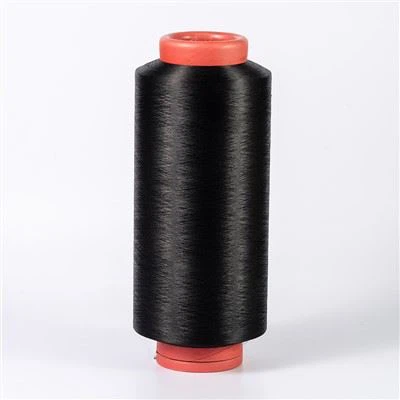


| Quick Details | |||
| Type: | Weaving Air Covering Yarn | Material: | polyester, nylon spandex |
| Style: | Air Covering | Technics: | Draw Ratio |
| Use: | For denim or socks making | Evenness: | Standard |
| Twist: | S/Z | Yarn Count: | 3075 |
| Strength: | Standard | Place of Origin: | Zhejiang, China |
| payment: | LC OR TT | Model Number: | 2075, 3075, 4075 |
| Colour: | White, Black, Color | Weight/carton: | 32kgs |
| MOQ: | 1000KGS | Features: | Eco-Friendly |
| Packing: | Export Standard | Certification: | Oeko-Tex Standard 100 and GRS |
| Grade: | AA Grade | Brand Name: | kangjiesi |
| Technical Point: | As customer request | Port: | Ningbo or Shanghai |
Supply Ability &Packaging &Delivery
Supply Ability
Supply Ability 30000 Kilogram/Kilograms per Month
Packaging & Delivery
Packaging Details 69cm*46.5cm*30cm
Lead Time:
|
Quantity(Kilograms) |
1 - 5000 |
>2000 |
|
Est. Time(days) |
7 |
To be negotiated |
|
Air-covered yarn (ACY) |
|
|
Raw material: |
Spandex + Polyester/nylon |
|
Twist: |
S/Z |
|
color: |
raw white, black, colors as requested |
|
Packing: |
PP bags inside, cartons outside carton size 69*46.5*30 5kg/cone,30kg/carton 300carton/20ft 700cartons/40hq |
|
spandex+polyester |
1575 2055 4055 2075 3075 4075 20150 30150 40150 70150 |
|
spandex+nylon |
2020 2030 2040 2070 3070 7070 7040 |
|
Certification: |
OEKO-TEX certification |
|
Application: |
Socks, Denim, Underwear, Swimwear, Sportswear, Gloves, Tights, Sweaters, Pantyhose, and other textile products |
| More details can be customized. | |
| Samples can be sent to check whether conform to your requirements. | |

PRODUCT APPLICATION


FAQ
Q:What is the weaving yarn??
A:
The process of forming woven fabric with yarn as warp and weft according to various fabric structures. It usually includes three parts: making warp yarn into spinning shaft, making weft yarn into pirn (or bobbin) before weaving, weaving and finishing. Weaving is an important part of textile industry production, according to the types of raw materials used can be divided into cotton, wool, silk and hemp weaving, its products are collectively referred to as woven fabrics. The varieties and uses of woven fabrics are extremely wide (see textiles), and suitable yarn raw materials and appropriate fabric organization are selected according to different use requirements.
The development of weaving technology has a history of more than 5,000 years, and has experienced the stages of primitive weaving, ordinary weaving, automatic weaving, shuttleless weaving and so on. The original weaving method is to tie one piece of yarn in turn to the same wooden roller, and the other end of the yarn in turn to the other wooden roller. After the two wooden rollers are tensed and fixed, use your fingers to stir the odd or even number of warp threads into the weft. After improvement, a small wooden roller is used to separate the warp yarns according to single and even numbers. When the layering of the warp is consistent with the small wood roll, the weft can be directly introduced along the small wood roll and the weft can be tightly knit. A small wooden roller unearthed at the Hemudu site in Yuyao, Zhejiang, China, may be a component of this very primitive loom. Later, flat wood knives or bone knives appeared instead of small wooden rolls for yarn splitting. People also found that with a discontinuous weft woven fabric, the warp on both sides is easy to loose, so the weft will be linked together, wound into a loop after the warp layer. As the fabric widens, a continuous weft is wound around a reed bar or a wooden pole, and a handle is used to draw it through the warp layer that has been stretched for the weft cutter. Because the weft cutter is easy to pass through the warp layer, a groove is carved on the weft cutter, and the small rod around the weft is embedded, which can not only draw the weft but also beat the weft, so that the weaving speed is further improved. Since then, the invention of thread harness threading tools and cross-stitch tools.
The original horizontal loom and vertical loom are not suitable for weaving silk fabrics, so after reform, the oblique loom is suitable for weaving silk fabrics. The oblique loom uses the lever principle, and it is possible for the operator to use hands and feet, and the weaving speed is greatly improved. The early reed (ancient called 筬) consisted of finely split bamboo teeth with thin and evenly spaced teeth fixed in the wood. Later, in order to control the fabric more effectively, the side brace was invented. After the reed appears, it can replace the filling knife. So the weft cutter evolved into a hollow, sharpened tool with a smooth surface. The insertion of the weft tube into the void is the pattern of Chinese Han Dynasty stone relief. Weaving cloth with Zhu can be thrown with both hands, speeding up the weaving speed.
The shed formed by the oblique loom is relatively small, inconvenient to operate, and can not be used to weave large patterns of silk fabrics, and then the horizontal loom with a frame appeared. The opening device has become complicated from simple, and the heald frame has increased from a dozen pages to hundreds of pages. When the wooden frame cannot accommodate it, a wire harness is used to lift a single warp. The more complex the pattern, the more roots of the harness will be used. Later, the lines that move up and down the same are combined together to form a bundle. The use of harness provides conditions for weaving complex patterns. The organizational structure is becoming more complex, and the number of healds can even reach thousands of healds. From 73 BC to 49 BC, the wife of Chen Baoguang, a giant deer in Hebei, China, simplified it into a jacquard machine from 120 to 120. AD 220 ~ 280 Chinese Ma Jun successfully changed the jacquard machine to 12 from 12 to 12, and today China's Sichuan Dingqiao loom can be powered by this.
With the development of sericulture, cocoon cooking and silk reeling, silk winching also developed. In the Spring and Autumn Period of China, simple silk frames were used to winch silk, in the Sui and Tang dynasties, hand-reeling wheels were used to winch silk, and reciprocating winching devices appeared in the Song Dynasty. Is it too small? Rolls can be used for warping. After the appearance of small wood rolls, healds and bamboo reed, the small wood rolls are used in warping, and the warp ends are passed through the healds and bamboo reed. Another winding method used in South Asia for cotton yarn is to wind the small capacity of the spinning wheel into a large capacity of the frame yarn, and then draw the warp from the frame yarn, through the weaver's hand guide roller zigzagged around the ground warping pile, and then through the yarn reed rolled on the wooden roll. In order to reduce warp breakage, cotton yarn must be starched after warping, which may be a creation of South Asian residents.
Hot Tags: weaving air covering yarn, China, suppliers, manufacturers, factory, wholesale, cheap, trendy yarn, weaving yarn, exhibition yarn, protective clothing yarn, anti pilling yarn, alluring yarn