



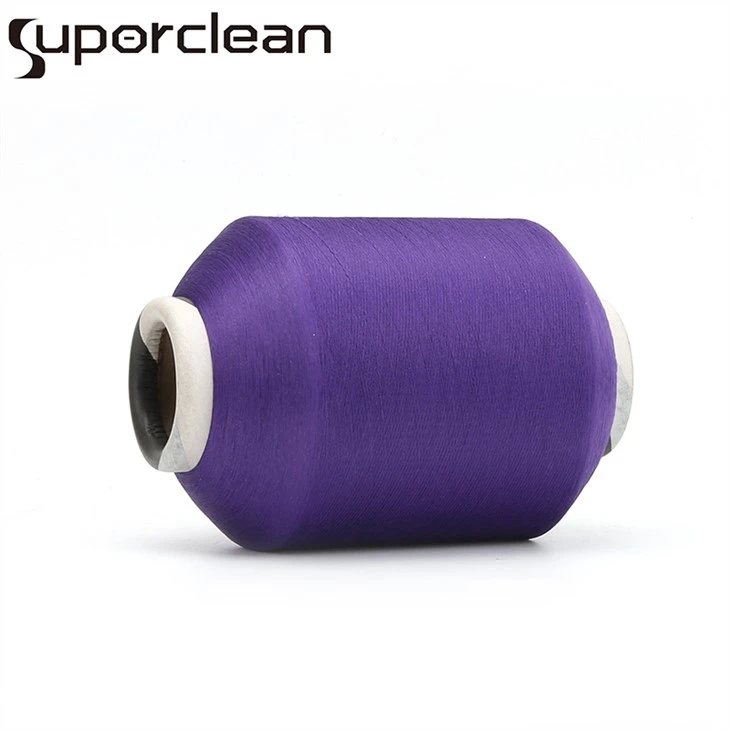

| Quick Details | |||
| Name: | 70D Spandex Socks Covered Yarn | Raw Material: | Spandex+Nylon |
| Type: | Machine Covering | Technics: | single covered with tpm |
| Usage: | Socks | Evenness: | High Standard |
| Twist: | S/Z as you request | Yarn Count: |
2070 |
| Strength: | with high strength | Place of Origin: | Zhejiang, China |
| Brand Name: | Superclean | Item Number: |
2070 |
| Hs code : | 54026920 | TPM: |
As Request |
| MOQ: | 100KGS | Colour: | Colors as required |
| Features: | Eco-Friendly | Packing: | Export Standard |
| Certification: | Oeko-Tex Standard 100/GRS | Grade: | AA Grade |
| Technical Point: | as required | Port: | Ningbo or Shanghai |
Supply Ability &Packaging &Delivery
Supply Ability
Supply Ability 20000 Kilogram/Kilograms per Month
Packaging & Delivery
Packaging Details 66cm*33.5cm*42.5cm
Lead Time:
|
Quantity(Kilograms) |
1 - 1000 |
>1000 |
|
Est. Time(days) |
7 |
To be negotiated |

PRODUCT APPLICATION
PUT INTO USE
100%SERVICE100%PASSION100%SATISF ACTION QUALITY FIRST CLIENT SUPREME
Our yarn can be used for leggings, silk socks, denim, bra, socks, underwear, ribbons, elastic tapes, gloves, shoe uppers, and so on.

PRODUCTION LINE
WE HAVE BEEN PROFESSIONALLY WORKING ON MANUFACTURING SPANDEX-COVERED YARN FOR 20 YEARS
1 SPOOLING: Purchasing high-quality material and spooling it onto aluminum tube
2 THREADING: Threading spandex, polyester, or nylon on the machine to start the covering.
3 DOFFING: After finishing, doff the spandex-covered yam onto the yan carrier.
4 CHECKING: Checking if there is ill-shaped yam or quality issue.
5 PACKING: Every carton uses plastic tape with the same length and width.
6 WAREHOUSING: Storing yarn in the warehouse and keeping the stable temperature and moisture.
7 LOADING: Load the carton into the container.

1. SPOOLING
Purchasing high-quality material and spooling it onto an aluminum tube.

2. THREADING
Threading spandex, polyester, or nylon on the machine to start the covering.

3. DOFFING
After finishing, doffing the spandex-covered yam on to yam carer.

4. CHECKING
Checking if there is an ill-shaped yarn or quality issue.

5. PACKING
Every carton uses plastic tape with the same length and width.

6. WAREHOUSING
Storing yarn in the warehouse and keeping the stable temperature and moisture.

7. LOADING
Loading the carton into the container.
Company Profile
 |
 |
|

DELIVERY&TRANSPORTATION
Support express, shipping, air transportation, rail transport, and so on.

Why Choose US
High Standard Workshop
Founded in 2016, the company covers an area of more than 30,000 square meters and is a production and sales enterprise specializing in norma yarn and functional yarn development.
Excellent After-sales service
We are a factory with superior after-sales service. We also have an innovation department which can help you develop new products. We can provide comprehensive textile production solutions.
Rigorous Quality Control
We will check if there is a shaped yarn or quality issue. Each carton is packed with a plastic tape of the same length and width. Storing yarn in the warehouse and keeping it in stable temperature and moisture to ensure quality.
Strict Production Flow
Strict production processes, automatic packaging, and strict delivery procedures, all to provide customers with the best quality service.
FAQ
1Q: Do You Know The Factors Affecting the Dyeing Performance of Nylon?
A: 1. The influence of fabric and fiber structure
From the perspective of the entire dyeing and finishing process, the most direct reason affecting the uniformity of nylon dyeing is the uneven warp and weft density of the fabric, the different yarn counts, and the different production batches of nylon fibers used on the fabric. It may affect the dyeing performance of nylon, resulting in uneven dyeing.
From the perspective of fiber, the chemical structure of nylon fiber is polyamide, and there is a certain amount of amino groups at the end of the fiber molecular chain. The dyeing characteristics of nylon are affected by the chemical and physical differences of the fibers, which may arise from the manufacturing process or processing of the fibers. , they directly affect the dyeing properties of dyes. The chemical difference comes from the difference in the amino acid content of the fibers, which may be produced during the spinning process, thermal drawing process, or paralleling process.
Differences in amino group content can lead to differences in dye uptake rates and especially final adsorption of anionic dyes, which can only be minimized through careful control of the production process.
The difference in the physical structure of the yarn mainly includes two aspects: on the one hand, it comes from the overall physical difference of the yarn, including the yarn count, the number of fibers in the yarn or the denier of the fiber, and the curling of the end of a single fiber in the yarn. Or the difference between the crimps of multiple fiber ends; on the other hand, it comes from the heterogeneity of the supramolecular structure produced during the processing of nylon fibers, such as the crystallinity in the fiber, the difference in orientation, or the skin-core structure. equal. When dyeing fabrics made of chemically or physically different nylon fibers, a characteristic weft color stripe is easily produced.
2. The influence of pretreatment conditions
Improper selection of pre-treatment conditions for nylon fabrics is also an important factor causing uneven dyeing. Improper fabric pretreatment mainly includes: uneven fabric treatment, which causes great differences in the adsorption properties of fibers, resulting in dyeing and hair loss; rapid heating of nylon filaments in the pretreatment process of jigger dyeing machines causes sudden shrinkage of nylon filaments, or temperature fluctuations during heat setting Inhomogeneity will cause structural differences in nylon fibers, and uneven dyeing will occur during the dyeing process.
3. The influence of dyeing conditions
①Influence of temperature
Nylon is a thermoplastic fiber. Therefore, the dyeing rate of the fiber has a great relationship with the temperature, and the dyeing temperature must be higher than the glass transition temperature of the fiber (35-50°C). Nylon fibers begin to absorb dyes at 40°C. As the temperature rises, the dyeing rate accelerates, and the dyeing process can be basically completed at 100°C. Although the dyeing can be basically completed when the temperature is 100°C, continuing to heat up will help In the migration of dyes, so that the level dyeing can be improved. Some researchers believe that the dye uptake rate of nylon fibers dyed with acid dyes is related to temperature. When the temperature is higher than the glass transition temperature, the mobility of the macromolecular chain in the fiber is enhanced, and the fiber is opened, allowing the dye to penetrate into the fiber and react with the terminal amino cation, but if the heating rate is not well controlled, it is easy to produce uneven dyeing Phenomenon.
②Influence of pH value
When dyeing nylon fiber, when the pH value of the dye solution is relatively high, the dye is rarely dyed; when the pH value of the dye solution drops to a certain value, the dye begins to dye, and soon reaches saturation, continue to reduce the pH value of the dyeing night , the dye uptake did not increase significantly; however, when the pH value further decreased to 3, the dye uptake increased sharply, and super-equivalent adsorption occurred. When nylon fiber is dyed under the condition of very low pH value, it will also be hydrolyzed, especially after super-equivalent adsorption, the pH value in the fiber is lower than that in the solution, the hydrolysis is accelerated, and more amino groups are produced after hydrolysis. With increased accessibility, more dye can be adsorbed, making it easier to produce uneven dyeing. Therefore, according to the actual situation, the pH value can be adjusted to reduce the phenomenon of color flower.
③Influence of additives
Nylon fibers are mostly dyed with acid dyes, and the leveling agents of acid dyes mainly include anionic, cationic and nonionic. The anionic leveling agent has a certain affinity to the fiber in the acidic medium, and has a dyeing effect on the fiber with the dye anion. Its affinity is lower than that of the dye anion, but the diffusion rate is faster than that of the dye anion. At the beginning of dyeing, the anionic leveling agent competes with the dye for the dyeing seat. Due to the fast diffusion rate, they dye the fiber before the dye anion, combine with the -NH on the fiber, and then are gradually replaced by the dye anion with a high affinity for the fiber. Down, this reduces the initial dyeing rate of the dye and achieves a level dyeing effect.
Cationic and non-ionic leveling agents combine with dye anions to reduce the effective concentration of dye anions, and gradually release dye anions during the dyeing process to play a leveling effect. In addition, factors such as dyeing time, dye compatibility, dye liquor concentration, bath ratio and dye liquor circulation rate will also affect the level dyeing effect of nylon dyeing.
Hot Tags: 70d spandex socks covered yarn, China, suppliers, manufacturers, factory, wholesale, cheap, non stretch yarn, yarn in fashion industry, yarn management, yarn shipment, yarn in industrial textiles, ceramic yarn


